The Mesquite Mile:  Building mutual resilience through urban/rural exchange.

1 Comment

The Mesquite Mile: Building mutual resilience through urban/rural exchange.

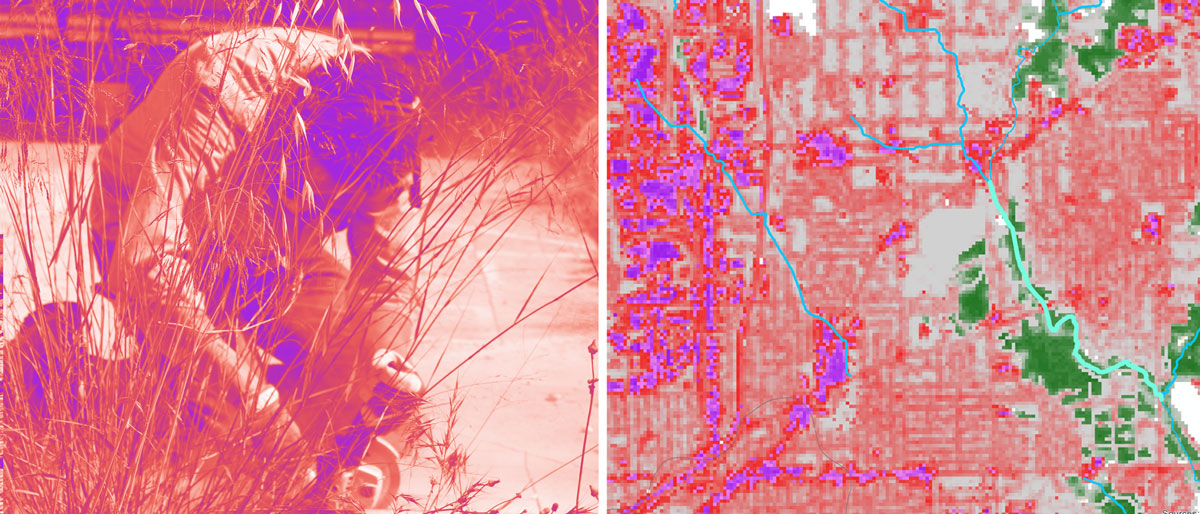
The Mesquite Mile is a multi-phase project based in Lubbock, TX. It aims to relocate regionally historic Mesquites (genus Prosopis) from commercial agricultural land (where they are maligned and removed) to Lubbock’s urban core (where they can be properly managed as assets). The project utilizes art as a tool to create a drought resistant shade canopy and public food forest—converting lawns and surplus space into interconnected rainwater harvesting earthworks that reimagine the narrative of this vital keystone species. See more about the work by visiting the Interchange Artist Grant website and our collaborators Travis Neel and Erin Charpentier at workabout.space/

Partners include:

Heart of Lubbock Neighborhood Association—The organization will assist in community outreach and education—helping to locate families and landlord participants. 

Heart of Lubbock Community Gardeners—The Gardeners will donate time and will help with community outreach, education and food forest stewardship. 

Texas Tech University School of Art will provide in-kind volunteer support through service-learning coursework, engaging students with the construction and maintenance of the food forest. 

Texas Tech School of Landscape Architecture will provide in-kind support to the project by providing service-learning coursework, engaging students with the planning and design of food forest plantings. 


See more on our instagram page for the project

1 Comment

Two Public Presentations in a Time of Pandemic

Comment

Two Public Presentations in a Time of Pandemic

Zoom fatigue notwithstanding, Commonstudio founders have had the pleasure of two pandemic presentations.

The first was an artist talk, given by Kim Karlsrud for Graceland Universtiy’s school of visual and Performing arts faculty and students. In it she shared recent work, including a recent gallery-based installation entitled Large and Round When Popped (2020). This work consisted of millions of popcorn kernals deployed in a sprawling field condition on the floor of the University’s Constance Gallery.

DJI_0401.jpg

The second was a conference presentation for the TNOC Festival, organized by TheNatureofCities.com. Here we screened a 2017 short documentary film entitled 11 Palms to an audience of like-minded urban ecologists, designers, and artists. A lively discussion about the nature of care, and the care of nature followed.

11_Palms_Screenshot_1.jpg

Comment

LHUCA Exhibition

1 Comment

LHUCA Exhibition

Below, Kim Karlsrud discusses her process for a recent solo exhibition at the Louise Hopkins Underwood Center for the Arts (LHUCA). The show ran between December 4 – January 30, 2021 in the John F. Lott Gallery. Click HERE for more information.

1 Comment

STRAINS Project Update: Planting Canna Lilies at the Sowl lake study site

1 Comment

STRAINS Project Update: Planting Canna Lilies at the Sowl lake study site

Update on our recently built “Model Nallah” at Sowl lake! The current configuration compares the performance of terracotta rubble to granite gravel aggregate in the treatment of real urban wastewater from the surrounding city. Recently our team introduced dozens of Canna Lilies (Canna indica) into the system to assess planted vs. non-planted performance characteristics. It will also anticipate the possibility for multi-functional benefits of STRAINS interventions, capable of providing a range of visual interest and ecosystem services when introduced into open drains throughout the city.

1 Comment

Commonstudio Founders to Facilitate Three Day "de-paving" Workshop at ISU College of Design

Comment

Commonstudio Founders to Facilitate Three Day "de-paving" Workshop at ISU College of Design

Commonstudio Founders Kim and Daniel in collaboration with Firat Erdim, will be facilitating a three day workshop with 80 undergraduate architecture students at Iowa State University’s College of Design. Drawing upon insights from an ongoing experimental intervention currently in development in the periphery of Rome, the workshop is entitled Depaving Des Moines: Catalysts for Landscape Change in the Urban Watershed. Over the course of three days, students will be introduced to various landscape methodologies and have a unique opportunity to get their hands dirty in the field with a live de-paving demonstration project within the Fourmile Creek watershed of Des Moines.

Comment

Commonstudio Receives $1000 Grant from The Pollination Project for Strategic in-Stream Systems (Strains).

Comment

Commonstudio Receives $1000 Grant from The Pollination Project for Strategic in-Stream Systems (Strains).

Bangalore, India. The Pollination Project, a nonprofit foundation that gives $1000 a day, every day, to individual change-makers and activists worldwide, awarded a grant to Commonstudio founders Daniel Phillips and Kim Karlsrud, creator/founder of Strategic In-Stream Systems (“Strains”) Project.

The project proposes small-scale, low-tech, in-stream decontamination strategies to be deployed and monitored throughout three distinct urban watersheds in India over the course of 4 years.  Our interdisciplinary team is already engaged in ongoing schematic design, lab-based material testing, and relationship building with local partners.  The STRAIN System is a modular system comprised of three basic stages aimed at 1) diverting and collecting solid waste  2) slowing and and settling sediment and suspended solids, and 3) lowering BOD, and trace metals levels through bio filtration using locally available aggregate materials.  Our initial findings demonstrate that these systems can be deployed and scaled at a low cost with an immediate positive impact on localized water quality.

We would like to thank the founders and committee members of the Pollination Project, for believing in our work and the impact on the urban watershed in Bangalore. This grant will help acquire much needed materials for our pilot project, due to begin construction in early 2018.

The Pollination Project gives seed grants to projects that benefit people, the planet, and animals in areas like environmental sustainability, social justice, community health and wellness, arts, and education. To view a full list of recipients to date please see: https://thepollinationproject.org/

Comment

Comment

Proceedings from the 2017 ATREE Work Seminar

Commonstudio founders Daniel and Kim were honored to participate in ATREE's "Annual Work Seminar."  We had a chance to present the current stage of our ongoing collaborative work with Dr. Priyanka Jamwal.  As was the case throughout the last year of applied research It was refreshing and exciting to be surrounded by such great scientific thinkers who help us push beyond our blind spots as designers.

20479821_1603510939672845_830046746267418678_n.jpg
AWS_Proceedings_2017[15240] 1.jpg

Comment

Commonstudio Receives Microgrant from the Awesome Foundation funding ongoing work in Bangalore.

Comment

Commonstudio Receives Microgrant from the Awesome Foundation funding ongoing work in Bangalore.

We are honored to have been awarded a microgrant from the Awesome Foundation (link to our project on their website, click HERE.

The $1000 Awesome Without Borders microgrant will contribute to the implimentation of a small scale intervention for the STRAINS system (currently in development with our Indian partner organizations). The intervention comprises of a designed structure which contains roughly 15 cubic meters of terracotta fragments. Terracotta is abundantly available and our preliminary research shows that it promotes the growth of biofilm, settles sediments, and reduces harmful pathogen content from black and greywater. The intervention will employ these fragments as a passive filtration material and substrate for the growth of spontaneous wetland plants over time. Working together, these systems will help lower the concentrations of harmful contaminants flowing through the watershed.

The Nallah we have chosen for the intervention is upstream of Sowl Lake in Bangalore’s southeastern periphery. Sowl is a perfect context as it is currently in the process of being revitalized and contains a series of preliminary filtration mechanisms. Our Strains unit will work in tandem with these other efforts already underway.

Funding will help purchase raw materials necessary to implement a small scale “proof of concept." Luckily, $1000 stretches much farther in the Indian context and will allow us to procure roughly 6 times more materials than if we were working in the US or EU.  Demonstrating success at Sowl will help us garner more funding and support to scale this idea strategically throughout Bangalore and beyond.  The goal is not commercial viability but open-source empowerment.

Comment